
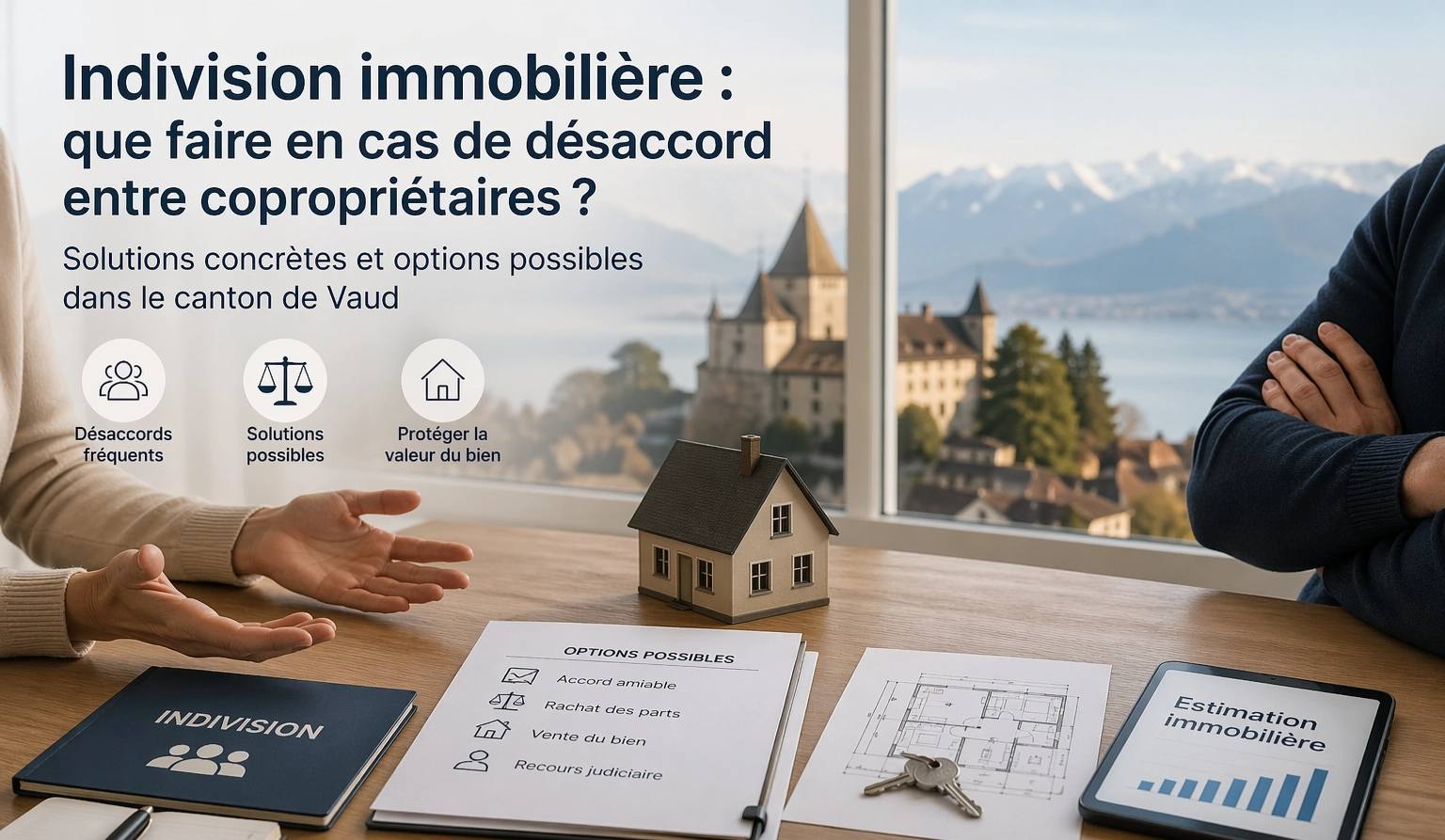
Real estate joint ownership: what to do in the event of disagreement | Vaud
Undivided ownership of real estate is a common situation, particularly following inheritance or separation.It involves several people owning a property together, without each being allocated a physical share. While this type of organization can work well in some cases, it often becomes a source of deadlock when co-owners do not share the same objectives. In this context, it is essential to understand the rules governing joint ownership and the options available in the event of disagreement.
Understanding how joint ownership works
In joint ownership, each co-owner owns a share of the property, but no specific part belongs to him or her individually.
In principle, important decisions require the agreement of all parties:
- the sale of the property,
- its rental,
- significant work,
- or any change in its use.
This unanimity rule is often at the root of blockages.
Why disagreements are frequent
Joint ownership situations often involve different profiles:
- some want to sell quickly,
- others want to keep the property,
- some don’t have the financial capacity to take on the burden,
- others have a long-term vision of their assets.
These differences make decision-making difficult and can lead to property paralysis.
What can be done in the event of disagreement?
There are several options for getting out of a deadlocked situation.
Reaching an amicable agreement
The first step is always to seek agreement between the co-owners.
This can involve :
- framed discussion,
- mediation,
- or an objective analysis of the property’s value.
In this context, a neutral assessment often helps to clarify positions and avoid unnecessary tensions.
A precise valuation of your property in the canton of Vaud is therefore essential.
Redemption of shares
One or more co-owners may decide to buy out the others.
This solution enables :
- to keep the property within the existing circle,
- simplify management,
- to avoid an external sale.
It does, however, presuppose sufficient financial capacity and agreement on the value of the property.
Selling the property
When no agreement is possible, sale is often the most pragmatic solution.
- It enables :
- put an end to indivision,
- to distribute cash,
- to get out of a bind.
In this case, an adapted sales strategy is essential to secure the whole process.
See how to sell a property in the canton of Vaud under the best possible conditions.
Legal recourse
As a last resort, a co-owner may apply to the courts to leave indivision.
This procedure can lead to a forced sale of the property, but it has several disadvantages:
- long lead times,
- high costs,
- loss of control over sales conditions.
It is generally considered a solution of last resort.
Anticipate to avoid blockages
Certain situations can be anticipated, such as
- by defining clear rules between co-owners,
- by regularly evaluating the property,
- by clarifying everyone’s objectives from the outset.
In more complex cases, structured support can help guide decisions and prevent the situation from deteriorating.
These situations often involve complex properties requiring a specific approach.
Conclusion
Real estate joint ownership can quickly become a source of tension when interests diverge.When faced with a disagreement, it’s essential to identify the options available and choose a solution suited to the situation.
Whether it’s an amicable agreement, a share buy-back or a sale, a structured approach generally helps to avoid cumbersome procedures and preserve the value of the property.